A shirt tells on you long before you speak. The collar frames the face, the shoulder line sets the tone, and a poorly judged sleeve length can quietly undo an otherwise polished look. That is why the question of custom shirt vs ready-made matters more than many men first assume. It is not simply about price or convenience. It is about how precisely a shirt supports the way you present yourself.
For some, ready-made shirts do the job well enough. For others, particularly men who rely on sharp business dress, wedding attire or a more considered wardrobe, custom becomes the point where clothing stops being generic and starts becoming personal. The difference is visible, but it is also felt in movement, comfort and confidence.
Custom shirt vs ready-made: the real difference
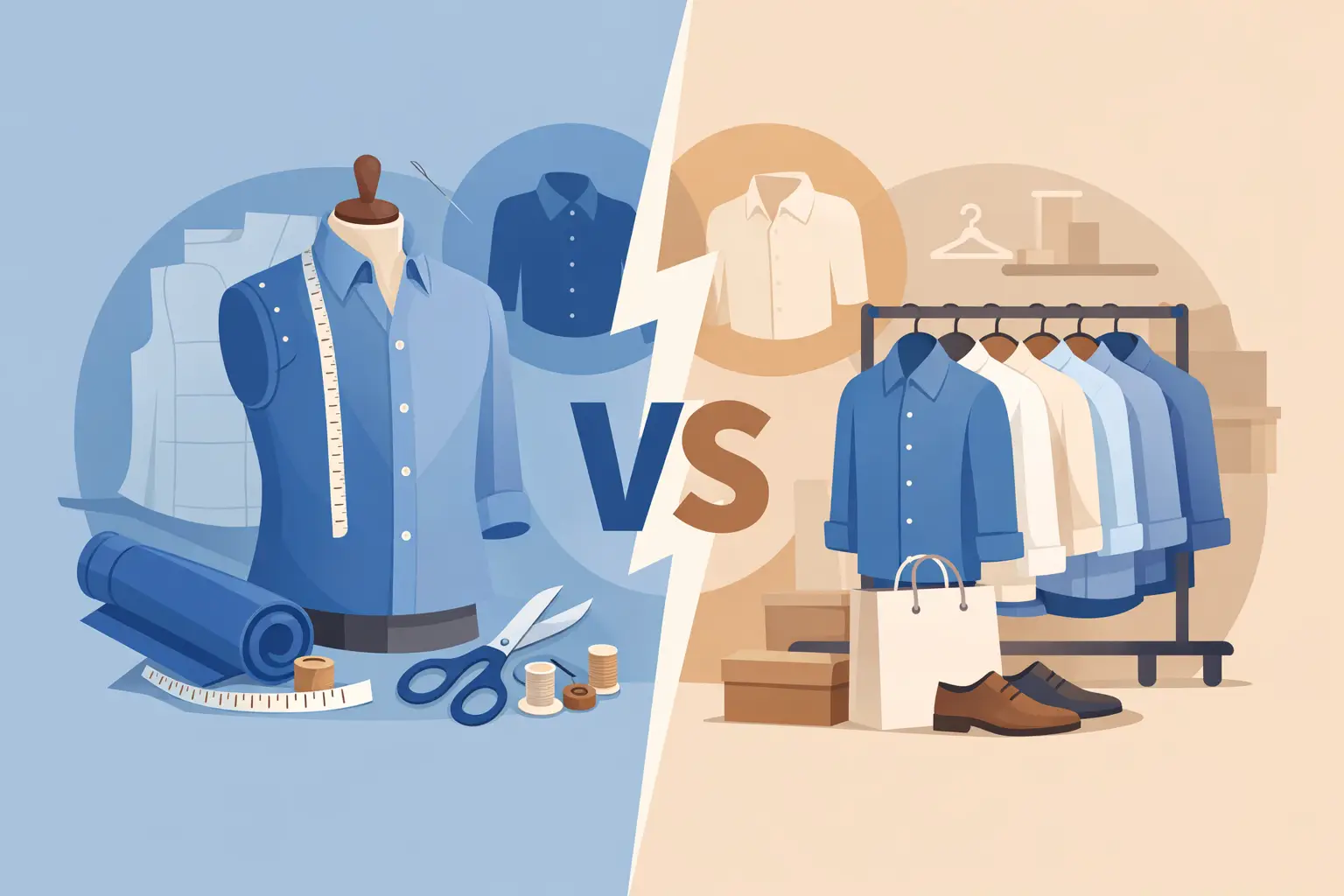
At a glance, the distinction seems straightforward. A ready-made shirt is produced to standard sizing and sold off the rack. A custom shirt is cut to your individual measurements, with choices around cloth, collar, cuffs, placket, buttons and finishing. Yet the real difference goes deeper than measurement alone.
Ready-made shirts are designed for an average body that does not truly exist. They are built around broad sizing categories, which means most men are compromising somewhere – perhaps the neck fits but the body billows, the shoulders sit correctly but the sleeves fall short, or the chest feels comfortable while the waist carries excess cloth. None of this is catastrophic, but it does affect the line of the garment.
A custom shirt is built to resolve those tensions. It accounts for your posture, shoulder slope, arm length, chest shape and waist proportion. It can also accommodate preferences that standard sizing rarely handles well, such as a cleaner fit under tailoring, more room through the midsection without excess fabric elsewhere, or a collar height that sits properly against the neck.
Fit is where custom shirts justify themselves
Fit is the first and strongest argument for going custom. An excellent shirt should follow the body without pulling, draping cleanly under a jacket and remaining elegant when worn on its own. That balance is difficult to achieve off the peg, because retail brands must design for scale rather than individuality.
When a shirt is made specifically for you, the shoulder seam lands where it should. The collar closes comfortably without feeling restrictive. The sleeve breaks at the wrist rather than pooling into the hand or disappearing under the jacket sleeve. The body feels shaped, not squeezed.
This matters especially for professional wardrobes. A suit can only perform as well as the shirt beneath it. If the shirt balloons at the waist or strains at the buttons, the whole silhouette is compromised. The same is true for wedding dress, where photographs preserve every proportion. A shirt with the correct collar spread, cuff depth and body line brings a cleaner, more refined finish to the entire look.
Why ready-made sizing often falls short
Most men are not one standard measurement from neck to hem. A man may have a broader chest from training, a narrower waist, one shoulder slightly lower than the other, or longer arms than standard sizing allows for. Ready-made shirts handle this by forcing the wearer into the nearest approximation.
Sometimes that approximation is acceptable. If your build aligns closely with standard blocks and the shirt is intended for occasional or casual use, ready-made can be practical. But if you wear shirts frequently, or if presentation is part of your professional identity, those small inaccuracies become more noticeable with every wear.
Fabric, collar and finishing change the experience
A shirt is not just a shape. Its character comes from cloth and construction. This is another area where custom offers a different level of sophistication.
With ready-made, the choice is limited to what a brand has selected for a season. You may find a suitable white poplin or pale blue twill, but perhaps not in the exact weight, texture or pattern that best complements your wardrobe. Collar options are similarly restricted. If you favour a more assertive spread for business tailoring, or a softer construction for elegant off-duty wear, retail options can feel oddly narrow.
Custom allows the shirt to be designed around use. A crisp cotton for boardroom sharpness, a breathable weave for warmer months, a subtle stripe for depth beneath navy tailoring, or a more formal front for evening dress. Equally important, the collar can be chosen to suit your face shape, tie knot and jacket lapel. These details sound small until you see how much composure they bring to the whole ensemble.
Finishing also tends to be more meticulous in a well-made custom shirt. Cleaner pattern matching, better button attachment, more considered cuff construction and a more balanced collar all contribute to longevity and visual polish. These are not decorative luxuries. They are the marks of a shirt made with intention.
Is custom always better value?
Not automatically. This is where nuance matters.
If you need a shirt immediately for occasional wear and your proportions happen to suit standard sizing, a well-chosen ready-made shirt can be perfectly sensible. It offers convenience, speed and a lower initial outlay. For many men, that will be enough for certain parts of the wardrobe.
But value is not only about ticket price. It is about cost per wear, durability and how often the garment is genuinely chosen. A cheaper shirt that never feels quite right often ends up neglected at the back of the wardrobe. A custom shirt that fits properly, looks sharp and feels comfortable tends to be worn more often and with greater confidence.
There is also the issue of alterations. Many men buy ready-made shirts only to spend more adjusting sleeves, tapering the body or trying to improve the fit. Alterations can help, but they cannot fully remake the architecture of an off-the-peg shirt. Once those costs are added, the gap between ready-made and custom can narrow considerably.
When ready-made makes sense
There are situations where ready-made is entirely reasonable. If you want a simpler casual shirt, need something at short notice, or are still working out your preferences in collars and fit, buying ready-made can be a useful starting point. It can also suit men whose bodies sit neatly within standard sizing and who are less concerned with a sculpted silhouette.
The key is discernment. Not every ready-made shirt is poor, and not every wearer needs custom for every occasion. The better question is whether standard sizing serves the role the shirt must play. For relaxed use, perhaps yes. For high-visibility settings, often not.
When custom becomes the smarter choice
Custom shirts come into their own when the shirt has a job to do. Business wardrobes benefit because consistency matters. If you wear a shirt several times a week, even minor fit irritations become significant. Weddings and formal events demand precision because the shirt is part of a carefully built look, not an afterthought. Men who wear tailoring regularly will usually find that custom shirts sit better beneath jackets, hold their collar shape more elegantly and create a more intentional silhouette.
They are also the stronger option for men who struggle with ready-made sizing. A fuller chest, sloping shoulders, a longer torso, athletic proportions or a preference for a cleaner waist all make standard shirts less reliable. In these cases, custom is less about indulgence and more about solving a problem properly.
For clients building a wardrobe with longevity in mind, custom also offers continuity. Once a pattern has been refined, future shirts become easier to commission with confidence. You are no longer starting from zero each time. You are developing a wardrobe with coherence.
The question is not custom or ready-made forever
The most sensible wardrobes are rarely ideological. They are selective. You may keep a few ready-made shirts for travel, casual wear or immediate needs, while relying on custom for business, ceremony and the pieces that shape your image most directly.
That is often the mature answer to custom shirt vs ready-made. One is not universally right, but one is unquestionably better when fit, presence and individuality matter. A shirt should not merely cover the body. It should sharpen it, balance it and present it to advantage.
At Manndiip, that philosophy sits at the centre of how garments are cut and finished. A shirt worth wearing should feel considered from the collar outward, not merely acceptable because it happened to be available in your size.
The right shirt is the one that earns its place each time you dress. If it makes you stand straighter, look cleaner and feel entirely yourself, the decision has already been made.